
The Poppies of Terra #76 - In Praise of Starfleet Academy
By Alvaro Zinos-Amaro
2026-02-25 09:00:01
August, 1993.
A new series of Star Trek tie-in books boldly debuts: Star Trek: The Next Generation: Starfleet Academy.
The inaugural volume, Worf’s First Adventure, was penned by none other than Peter David. He followed it up with books two and three, creating an introductory Worf-centered trilogy that doubles as an unofficial prequel to David’s own nineteen-volume Star Trek: New Frontier spinoff series.
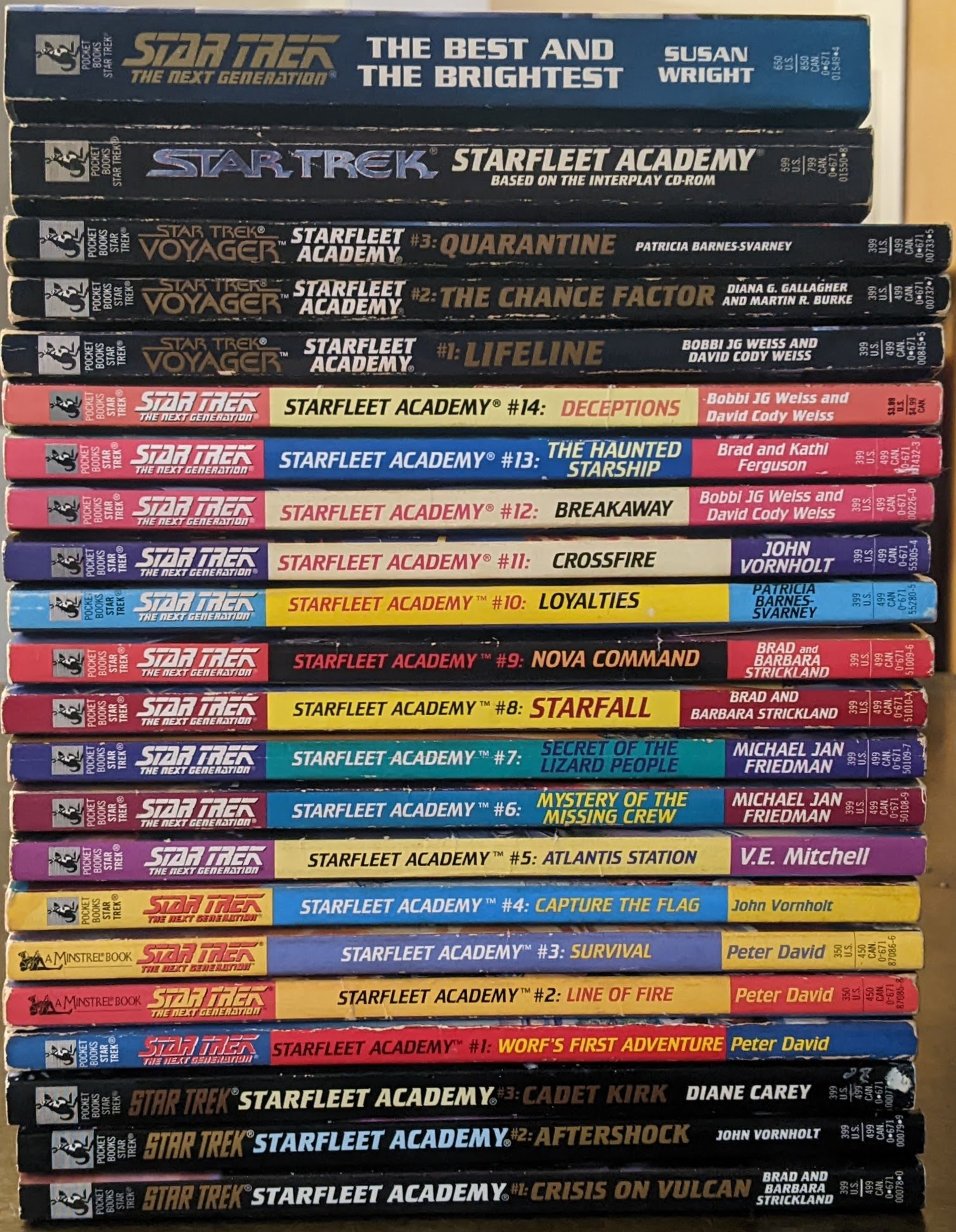
In all, Star Trek: The Next Generation: Starfleet Academy would go on to number fourteen digest-sized paperbacks, featuring the early adventures of most beloved TNG characters. These books were intended for middle grade/YA readers and featured (mostly) top-notch illustrations every couple of chapters.
In time this version of the Starfleet Academy universe would receive a further six volumes, three of them featuring The Original Series characters and three of them centered on Star Trek: Voyager’s Kathryn Janeway.
Lisa Clancy, who edited the Starfleet Academy book series, has shared that the line was born when she worked in the Young Adult department of Pocket Books, and was inspired by news that the new show, Deep Space Nine, was going to feature a recurring kid character. Clancy met with Kevin Ryan and Dave Stern, and together they pitched the concept of a YA book series to Gina Centrello. As Clancy recalls: “Trek publishing was on an upswing, with multiple title releases every month. Dave and Kevin were very supportive, and hooked me up with Peter David to launch the Next Gen/YA series with a trilogy of Worf titles. After that, I was on my own.”
As Clancy has also shared: “Worf was the best character to start with, I thought. Kids would relate to him. He felt different, he knew he looked different, and when he was angry he preferred to hit things.” I think that was a clever move, and gives the first book, which won the Middle Grade Golden Duck award in 1994, its enduring value. “Taking all of the Next Gen characters back to their younger, academy days would allow the readers to experience familiar characters but with relatable problems—how do I survive the class bully? How do I decide what courses to take? What’s it going to be like living on my own for the first time? How badly did I screw up my first command?” (source: Jeff Ayers, Voyages of Imagination: The Star Trek Fiction Companion)
DS9 received its own twelve-book YA series, naturally focused on the adventures of Jake Sisko and Nog. I’ve written about these books elsewhere. So, all four Trek series were represented in this format, with the three of them that were most viable specifically getting the Starfleet Academy treatment.
The concept of a Starfleet Academy story goes back much farther, however. It was kicked around with some seriousness in the wake of Star Trek V: The Final Frontier. For an interesting look at that early incarnation I recommend pages 95-99 of Edward Gross’ The Making of the Trek Films. As Gross notes in that book, the novel Enterprise: The First Adventure, “bore some resemblance to Harve Bennett and David Loughery’s proposed” story. More discussion of this unrealized Trek vision is available in the The Fifty-Year Mission: The Complete, Uncensored, Unauthorized Oral History of Star Trek, volumes one and two, which recycle material from the earlier Gross book and augmented it with a number of other un-accredited interviews.
Opines Glen C. Oliver in the second oral history tome:
“Star Trek: The Academy Years, often erroneously referred to as Starfleet Academy, was scripted by Star Trek V’s David Loughery for Harve Bennett; it chronicled how young Kirk and Spock, and other TOS mainstays meet, and become friends, at Starfleet Academy. Colored by more than a few shades of Top Gun, the screenplay was filled with tremendous moments of warmth and heart—and focused heavily on its characters’ journeys toward understanding themselves individually, and recognizing their potential as a group.
It was as character-centric as The Wrath of Khan and Search for Spock, and featured the same unapologetic devotion to exploring the human condition demonstrated by those titles. Despite a few misplaced, miscalculated attempts at humor, there’s a lot of “truth” in Loughery’s work in The Academy Years—touchingly, surprisingly, admirably so at times. This would’ve been a very nice and affecting origin story when factored into the broader framework of the franchise, and that it didn’t make it to screens remains highly regrettable.”– Edward Gross. The Fifty-Year Mission: The Next 25 Years
I remember with fondness reading the first three or four titles in the Star Trek: The Next Generation: Starfleet Academy series over Christmas break when I was a teenager. These were very quick, single-sitting reads, with neat nods to continuity, depicting characters who sounded like suitably less experienced versions of their on-screen selves. What made the books more than empty calories was that their narrative hijinks clearly served the exploration and reinforcement of classic Star Trek ideals.
In this sense, while the books were clearly written to engage primarily with younger readers, they felt of a piece with the grander vision of Roddenberry- and Berman-era Trek.
I recently went back and read all twenty of these Starfleet Academy adventures. If that sounds daunting, let me reassure you that it isn’t. Even if you just cruise through two a week, easily done during miscellaneous moments, you’ll get through the full set in a mere ten weeks, which happens to be the same amount of time it takes for, say, a ten-episode television season of a modern-day series to air.
As a supplement, I read Diane Carey’s first-person novelization of the Starfleet Academy computer game (here’s the full 60-video playthrough, in case you’re curious), told from the perspective of one David Forester. Carey called this book “some of the most entertaining writing I’ve ever done” and I can’t disagree.
Finally, I also read Susan Wright’s Star Trek: The Next Generation: The Best and the Brightest, which, in an interesting mosaic approach, follows six cadets–original characters this time–over their four-year Academy term. The novel features a number of cameos by well-known characters and action that’s often adjacent to major events. According to author Wright, this book holds the distinction of being “the first Star Trek novel with main characters who were gay.” Moll Enor and Jayme Miranda are definitely standouts.
For those looking for even more Starfleet Academy goodness, there’s also a dedicated Marvel comics miniseries that ran for nineteen issues, and the well-regarded novel Academy: Collision Course written by William Shatner with Judith and Garfield Reeves-Stevens, intended to be the first in a new series that was cut short.
While reading the twenty-two books mentioned, I highlighted what I thought were quintessential Starfleet Academy values, moments, or insights.
What follows are what I’ll call these “Academy Lessons,” my selection of quotable beats from each book.
And at the end of this piece, in case you’re looking for an abbreviated list, I’ll share my curated selection of what I think are the best titles.
Star Trek: The Next Generation: Starfleet Academy
1 Worf's First Adventure (1993) by Peter David
“The point, gentlemen, is that space is a very unforgiving environment. It’s cold. It’s airless. It is not charitable, and it does not make allowances for such things as bigotry and hostility. The vacuum of space doesn’t care about your skin color, or your politics, or the strength in your arms, or the brains in your heads. You’ve got only two things going for you that can prevent a very swift, and very painful, death. The first is the integrity of your ship’s hull. And the second is each other.” (p. 28)
“...the reason people come to the Academy is to learn. And what you’re learning here is a lot more than facts and figures, ship names and stardates. You’re all learning a particular way of thinking.” (p. 84)
““The whole key to being a good Starfleet officer,” continued La Forge, “is not to be afraid of the unknown, but instead to embrace it. To be drawn to it, to study it. To be excited by it and want to share in its wonders. Believe it or not, that’s not an easy transition to make.”” (p. 86)
2 Line of Fire (1993) by Peter David
“Going through Starfleet training doesn’t rob you of your ability to be surprised. What it does do is force you to take those surprises on their own terms.” (p. 24)
3 Survival (1993) by Peter David
“If you refuse to believe that the sun is hot, does that make the sun any less hot? No, I think not. The universe does not hang on your approval of its nature. It simply is what it is. Believe anything other than that, if you care to. But you would be deluding yourself. And self-delusion is a luxury that a leader cannot afford.” (p. 13)
“It is interesting to observe,” said Zak, “that there are certain fundamental philosophies we all share.” (p. 82)
4 Capture the Flag (1994) by John Vornholt
“Starfleet Academy attracted only the best, the smartest, the most ambitious. They were young people who didn’t fear outer space or the unknown. They didn’t fear Romulans or Tholians. They wanted to command starships, space stations, planetary outposts, and have hundreds of people following their orders. Only failure at the Academy could stop them, and each cadet had his own secret fear about that.
Some feared subjects like trigonometry, exo-zoology, or quantum physics. Others worried that their superiors and fellow cadets wouldn’t like them. Many feared that they wouldn’t be able to pilot the training ships. A few were secretly homesick and didn’t know whether they would be able to spend years away from home. Some feared that they just weren’t good enough.” (p. 1)
“I’ve got news for you, La Forge—the Academy is tough on everybody. I’ve seen them come and go. The high and the mighty. The ones you think can’t miss do miss. The ones you think won’t last a year go on to be admirals.” (p. 14)
“Geordi knew from the years he had spent growing up on starships that mistakes often caused death. Real death, where people didn’t come back. Now all of the cadets would know it.” (p. 98)
“The measure of good officers, Geordi knew, was not how they performed, but how their crew performed when they weren’t around.” (p. 107)
“If I ever get to command—I know that’s a big if—I’m going to remember this day. I’m going to remember that brute force doesn’t always work. You’ve got to use your brain—and your heart.” (p. 110)
5 Atlantis Station (1994) by V. E. Mitchell
“The model was incredible. With all the details it showed, Geordi could have spent the rest of the day studying it. Suddenly he felt very small and unimportant. The universe held so many surprises and promised so many exciting adventures that he would need dozens of lifetimes to explore all the possibilities.” (p. 12)
6 Mystery of the Missing Crew (1995) by Michael Jan Friedman
“That was only a temporary union, born of mutual danger and necessity, the android told himself as he headed for an empty table in a solitary comer. But as he sat down, he couldn’t help but wish that it were otherwise. He had valued the experience of being part of a group. And now that he knew what that was like, it made it more difficult to be separate and alone again.” (p. 116)
“That was an aspect of the situation that hadn’t occurred to him—and a rather intriguing aspect at that. It was possible, he reflected, for two parties to benefit from the same experience in different ways. He would have to remember that, he told himself, storing the knowledge away for future reference.” (p. 118)
7 Secret of the Lizard People (1995) by Michael Jan Friedman
“Like any Starfleet officer, I hate the idea of allowing any life-form, even a hostile one, to be destroyed.” (p. 61)
“After all, Thorsson was the one who had encouraged Data to join Starfleet in the first place. It was the only way, the captain had told him, that he would be able to satisfy his enormous curiosity about the universe.” (p. 94)
8 Starfall (1995) by Barbara Strickland and Brad Strickland
“Unfortunately, he ran out of time with five problems left to go and with a time score that put him down around the eighty-seventh percentile. That would have been a respectable score in a typical classroom, but Starfleet demanded ninetieth or higher.” (p. 59)
“Devlin, he decided, would have approved of Starfleet’s gradual evolution from a military service to one devoted to the gaining of scientific knowledge.” (p. 61)
“You saved the lives of your own crew,” Trevalion pointed out. “Something the original commander of the Ponce de Leon could not do. And the others were only Romulans.”
Anger seethed inside Jean-Luc. “No one is ‘only’ anything,” he said. “Life is life. If we can’t give it back, we shouldn’t take it—at least, not lightly.” (p. 89)
“For all its worries, his past had been comfortable, known, reliable. But the future—well, the future was vast and unknown, and it stretched ahead for long, long years.
Jean-Luc straightened his shoulders and smiled in anticipation. Whatever that future might hold, he would live it among the stars.” (p. 111)
9 Nova Command (1995) by Barbara Strickland and Brad Strickland
“Jean-Luc sat entranced as Spock spoke briefly and simply of the duties the cadets were taking upon themselves. Spock pointed out that the galaxy was a huge place, still barely explored, and that new discoveries, new life-forms, new civilizations awaited them all. He barely mentioned his own career as a Starfleet science officer and diplomat, though everyone in the auditorium knew his story quite well.” (p. 6)
“However, let me say that my own mood at such times was always one of disappointment. Each time two sentient species fight, someone has failed. I urge you not to prefer combat to peaceful means of solving your problems.” (p. 8)
“I would say my best advice is this: See each crisis as an opportunity. Never believe you have learned all you need to know. And whenever possible, find a way to turn an adversary into an ally. If you can do these things, you will be a successful Starfleet officer.” (p. 9)
“Think of a Starfleet commander as a kind of rare plant. He’s got to find the right soil to grow in. Yours seems to be wherever leadership is needed.” (p. 114)
10 Loyalties (1996) by Patricia Barnes-Svarney
“If I may say so: you, too, Beverly, would make an excellent detective. You have the commitment to find out difficult answers. I have also noticed that such a quality is the sign of an excellent doctor—and Starfleet officer.” (p. 108)
““Mrs. Oner,” Beverly asked, kneeling down by the older woman as she packed, “what is it like being a doctor?”
Mrs. Oner stopped packing and hesitated. “It is difficult and beautiful,” she replied, then resumed packing. “You must help a patient under your care even when they seem to be difficult. You must help a patient even if you do not agree with them.”” (p. 115)
11 Crossfire (1996) by John Vornholt
“Starfleet Academy isn’t supposed to be easy. Getting used to upperclass cadets is sort of like getting used to the officers aboard ship who will outrank us. We’ll have to take orders from people we don’t know, people we may not even like. That’s discipline.” (p. 15-16)
12 Breakaway (1997) by Bobbi J. G. Weiss and David Cody Weiss
“Deanna grew serious. “Everybody, including me, needs advice. I accept that now. But knowing when to give advice and how to give it has been the problem between us all along. I want to help people, as you’ve helped me, Mother, but I want to be sure the people I advise really want my advice.” (p. 112)
13 The Haunted Starship (1997) by Brad Ferguson and Kathi Ferguson
“The sign made Geordi feel proud. He was officially part of the crew aboard a starship! Geordi was determined to do as good a job as he could, to be better than he had ever been before. There were people who believed in him–his parents, his teachers, his friends–and he wanted to justify their belief.” (p. 9-10)
“I guess there’s that tendency in all of us to fall back on superstition, even when we know better.” (p. 113)
14 Deceptions (1998) by Bobbi J. G. Weiss and David Cody Weiss
“Data wondered what to wish for. He could wish to be human, but of course, that was impossible. He could wish to know who made him and why, but he was somehow sure that the mystery of his origin couldn’t be solved by simple wishing. He finally decided to wish for a successful Starfleet career. After all, he intended to spend a good deal of his life in Starfleet, however long his life might last.” (p. 8)
Star Trek: Starfleet Academy
1 Crisis on Vulcan (1996) by Barbara Strickland and Brad Strickland
“I believe I do understand, Father. You have taught the Marathans the value of diplomacy, the logic of settling their disputes bloodlessly. You have given them a start on the path to full civilization.” (p. 11)
““After a moment, Spock said slowly, “I cannot see that there is a Vulcan science and a human science—or any other kind. There is only science.”
“That is an illogical statement,” Sirok said at once.
“No,” Spock insisted. “All science, whether it is Vulcan, human, even Klingon, aims at knowledge and truth. The methods used to gain those goals really do not matter as much as the results do.”” (p. 63)
2 Aftershock (1996) by John Vornholt
“All of Starfleet was about risking your life for other people, being part of a team, and putting duty before personal business. It was a sobering thought for a young man who was used to thinking mostly about himself.” (p. 48)
3 Cadet Kirk (1996) by Diane Carey
“Regulations don’t cover everything. That’s why we have a command structure—because experience counts for something.” (p. 73)
“There are rules about when to send distress signals, when to fight battles, how to pilot ships, how to handle supplies, even regulations on how we should treat each other. Although there are instances where following rules may not be the most efficient thing to do, overall we get the best results when we follow regulations. That is why we have senior officers and the rank system—experience is crucial in balancing the rules with the situation. Experience which, unfortunately, we all lack. You should never take casually the importance of following the rules, Cadet.” (p. 76)
Star Trek: Voyager: Starfleet Academy
1 Lifeline (1997) by Bobbi J. G. Weiss and David Cody Weiss
“Welcome to the beginning of your life, Kathryn, she thought to herself. What a frightening concept! Was she really up for this? She didn’t just want to do good in school–Kathryn wanted to be the best. If I study hard, I should be able to ace classes, she thought, but I’ll have to look into extra credit projects and campus organizations to boost my records.” (p. 22)
“You see, as a member of Starfleet, not only will the fate of your fellow shipmates and those under your command hang on your slightest actions, but upon occasion entire civilizations, planets, even whole star systems, will live or die by your performance. We don’t want competent beings. That’s a given. What we expect is the impossible as a matter of daily duty. If you don’t think you’re up to that, leave now.” (p. 35)
2 The Chance Factor (1997) by Martin R. Burke and Diana G. Gallagher
“The essence of exploration is the discovery of the unknown and, consequently, the handling of unpredictable situations. Starfleet officers have to be flexible in order to function effectively and they must be prepared to cope with the unexpected.” (p. 18)
“Everyone on the team, including the animals, had something significant to add to the whole. Although she didn’t trust everyone’s motives, she had learned to trust their individual talents. Separately, they couldn’t do the job. As a unit they could. It would just be a lot easier if they could overcome their differences of opinion and cultivated prejudices.” (p. 76)
“If a targ could have such a potentially powerful impact on the galaxy, how much difference could one human girl make? A lot, Kathryn decided. As a Starfleet officer with an understanding of different alien viewpoints and motives, social customs and beliefs, she could make a big difference in a lot of little ways.” (p. 101)
3 Quarantine (1997) by Patricia Barnes-Svarney
““That’s right, and like you and every other cadet, he started here at Starfleet Academy,” Boothby said, resuming his digging. “Yes, he was impatient like you. Always in a hurry. Not focusing on anything. Bold. Brassy. Always wanting to get ahead faster than anyone would let him. But his impatience was causing him to fail. To be nervous and fumbling. So he invented something to focus on. He called it Paraday’s Ladder.”
“Paraday’s Ladder? What’s that?”
“A vision he kept of a ladder. His own ladder. And each day, he’d step up one more step. One step at a time. No hurry—just at the right pace.”
“Where did the ladder go?” asked Kathryn, hoping to stump the groundskeeper.
“To the stars, Cadet,” said Boothby, his face turning slightly to look up to the bright sunlit sky. “To the stars.”” (p. 10)
“We’re both leaders, Kathryn. And leaders must protect their people by making some tough decisions.” (p. 110)
Starfleet Academy (1997) by Diane Carey
“Now you know that non-action has repercussions, just as action does. Sometimes a rash decision now is better than a thoughtful one five minutes from now. You’re about to go into command training on the most technologically advanced simulators in the galaxy. Don’t treat them like simulators. You never know what’s real and what’s not. What you learn at this Academy you’ll be taking with you … out there.” (p. 13)
“Commanders had to be emotionally removed to some degree from their crews—otherwise, how could a leader be expected to send his best friends out to their deaths? And we all had to be ready for that. The distance had to be firmly established, or no one could stand the pain. Military chain of command had been like this since the raw beginnings—a necessary coolness offset by loyalty to cause and active support. We weren’t supposed to be a family. We were supposed to be a crew.” (p. 82)
“As I watched one of the most famous men in Federation history move about only steps from me, I sensed a loneliness no one had ever mentioned. Were captains lonely?” (p. 102)
“Everything that happens on the ship is the commander’s domain. A captain who pays attention to the temperament and morale of his crew can count on that crew when he really needs them.” (p. 114)
“Regulations are for perfect situations. It’s up to you to make them fit imperfect ones. That’s why we don’t send computers out into space to make decisions. We go with them. We temper them with instinct and improvisation. That’s what we do best. The Academy can teach you how to apply the regulations to regular moments, but life in space is made up of thousands of hours of boredom offset by moments of abject terror. When that time hits, it’ll be you, and not regulations dealing with it.” (p. 123)
The Best and the Brightest (1997) by Susan Wright
“He knew it was dangerous sometimes being in Starfleet, but that was the trade-off you made for living life more intensely. He had already seen it and experienced it for himself during his field assignments. The people in Starfleet were getting more from every moment than anyone else in the galaxy, and he was glad to be part of that.” (p. 5)
“In Starfleet, we either win together or fail as a group. Here at the Academy, when a group regularly fails together, then we find that it serves in the long run to give them additional time to work things out.” (p. 60)
““Our elected officials create policy, not Starfleet captains,” Picard gently chided him. “While I may have quite a different opinion as a citizen, it would be arrogant in the extreme to think that I know what is best in such a complicated and far-reaching subject.”” (p. 142)
“Heroes are just people who do what needs to be done.” (p. 190)
Personal Top 5
-
Peter David’s Worf’s First Adventure remains the ideal starting point for this series. David nails the tone and creates a brisk and compelling yarn the primary lesson of which has only gained in importance and luster since the book’s publication over thirty years ago.
-
John Vornholt’s Capture the Flag is a truly nimble introduction to Geordi La Forge’s Academy days, with a number of excellent lessons sprinkled throughout the action. Vornholt, like David, is a prolific veteran of tie-in fiction, and handles his material with gusto and guile.
-
Barbara and Brad Strickland’s Starfall is a memorably-wrought introduction to a young Jean-Luc Picard and the emotional travails in the wake of his early failed attempt to gain admittance to the Academy. More serious in tone than the others, this has the same lasting impact as a number of adult Trek novels.
-
Bobbi J. G. and David Cody Weiss bring a fitting, Data-centric conclusion to the series with Deceptions, an absorbing xenoarcheological outing that explores the android’s early attempts to reconcile logic and trust.
-
Diane Carey’s Cadet Kirk is another series highlight, returning us to foundational material while still bringing a fresh angle. Readers of Best Destiny will get an additional kick from the slight overlap.
There you have it. A tribute, in quote form, to Starfleet Academy’s enduring ability to inspire and educate.
As I hope this survey shows, to the Academy’s motto of “Ex Astris, Scientia”, or “From the Stars, Knowledge,” we might add:
“Ex Fabulis, Sapientia.”
From stories, wisdom.